

 Sign in

 Български
 Čeština
 Dansk
Dansk
 Deutsch
 Eesti
Eesti
 Ελληνικά
 Español
 Français
 Hrvatski
 Italiano
 Latviešu
 Lietuvių
 Magyar
 Nederlands
 Norsk
Norsk
 Polski
 Português
 Română
 Slovenčina
 Slovenščina
 Српски (Ћирилица)
 Suomi
Suomi
 Svenska
 Türkçe
 Русский
 Українська
CLP Changes from July 2026
From July 2026, the first parts of the revision of the CLP Regulation will start to apply. The new rules mainly concern the labelling of small packaging, fold-out and digital labels, and the requirements for refill stations. Further changes will follow in 2027 and 2028.
The CLP revision was adopted by Regulation (EU) 2024/2865. However, the individual changes will enter into force gradually. Most of the changes concern the labelling of chemical products and the information that manufacturers or importers must include on the label.
The first group of changes will apply from 1 July 2026, followed by the next group from 1 January 2027. Some obligations were subsequently postponed until 1 January 2028 by Regulation (EU) 2025/2439.
Key changes applicable from 1 July 2026
Small packaging (up to 10 ml)
You do not need to include the labelling elements required under Article 17 on the inner packaging if one of the following conditions is met.
a) The product is contained in outer packaging with full labelling and is intended for:
- scientific research and development,
- analysis or quality control.
b) The product is not classified with any EUH statement and does not belong to any of the following hazard classes:
- acute toxicity,
- specific target organ toxicity – single exposure (H370, H371),
- specific target organ toxicity – repeated exposure,
- skin corrosion,
- serious eye damage,
- respiratory sensitisation,
- aspiration hazard,
- CMR (carcinogenic, mutagenic or toxic for reproduction),
- endocrine disruption for human health.
c) The product is classified with an EUH statement but does not belong to any of the hazard classes listed above. At the same time, it is contained in outer packaging with full labelling.
If the product meets any of these conditions, it is sufficient for the inner packaging to include:
- the product identifier,
- the relevant hazard pictogram or pictograms.
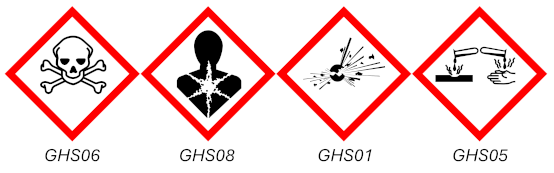
Where more than two hazard pictograms are required for the product, GHS06 and GHS08 take precedence over GHS01 and GHS05.
Fold-out label
The requirements specifying which information must appear on each panel of a fold-out label are now clearly defined. The label must include all labelling elements required under Article 17 of the CLP Regulation.
Front panel
The front panel must include:
- the supplier's name or company name, address and telephone number,
- the quantity of the product in packaging intended for the general public (if not indicated elsewhere),
- the product identifier in all languages used on the inner panels of the label,
- hazard pictograms,
- the signal word in all languages used on the inner panels of the label,
- the unique formula identifier (UFI),
- a reference to the complete safety information inside the fold-out label in all languages used, or a symbol indicating that the label can be unfolded to display additional information,
- the language abbreviation (country code or language code) for all languages used on the inner panels.
Inner panels
The inner panels must include all labelling elements required under Article 17(1), except for:
- hazard pictograms,
- supplier details.
Back panel
The back panel must include the same labelling elements as the front panel. However, it does not need to include the language abbreviations used on the inner panels.
Digital label
A digital label may now also be added to the physical label. The digital label complements the physical label. It may contain all labelling elements required under Article 17, as well as additional information, but it does not replace the mandatory information that must appear on the physical label.
The digital label must be permanently attached to, or printed on, the physical label or, alternatively, on the packaging next to the label. It must also be accessible using commonly available digital devices.
Certain information may be provided only on the digital label (Article 34a(2)), for example EUH statements or information relating to plant protection products. In such cases, the following statement must appear on the physical label:
“More hazard information available online.”
The digital label must ensure that the information is:
- easy to find,
- accessible within no more than two clicks,
- available to all users in the EU,
- available for at least 10 years, or longer where required by other legislation,
- presented in a way that takes into account the needs of vulnerable groups and promotes accessibility.
Where the information is available in more than one language, the choice of language must not be restricted based on the country from which the user accesses the information.
Refill stations
The Regulation now defines a refill station as a place where a supplier offers hazardous substances or mixtures for refilling. Refilling may be carried out manually or by means of equipment.
Refill stations must meet several requirements. For example:
- each hazardous substance or mixture must be labelled with the appropriate label,
- they must be designed so that children cannot operate them without supervision,
- the supplier must be present and available during the refilling process,
- employees must receive adequate training.
The Regulation also provides that substances or mixtures classified in the following hazard classes must not be sold through refill stations:
- acute toxicity,
- specific target organ toxicity,
- skin corrosion,
- serious eye damage,
- respiratory or skin sensitisation,
- aspiration hazard,
- CMR (carcinogenic, mutagenic or toxic for reproduction),
- flammable gases,
- flammable liquids, Categories 1 and 2,
- flammable solids,
- endocrine disruption for human health or the environment,
- PBT, vPvB,
- PMT, vPvM.
Not sure what these changes mean for your company?
Contact us. We will help you understand the new CLP requirements, review the labelling of your products and provide training for your employees.
Recommended sources
Note: This article is for information purposes only and does not replace the applicable legislation.

© 2026 SBLCore

